
When Your Child Is Born of Rape: A Confession, A Warning, and A Hope

When Your Child Is Born of Rape: A Confession, A Warning, and A Hope
*Content note: sexual violence, spiritual abuse, poverty, racism, parent–child conflict. Crisis resources at the end.*

Today, sitting with my daughter in a therapist’s office, I was confronted with something I wasn’t prepared to hear.
She told the therapist about a memory—about a day when she was younger, and I came home to find kids in my house when she wasn’t supposed to have anyone over. She said I put my hand over her nose and mouth and that she couldn’t breathe. She said it was traumatic for her.
And when she asked me, even later in the car, if I remembered it, I didn’t. I honestly don’t know if I blocked it out, or if my mind just won’t let me go back there. But for her, it’s real. It’s still fresh. It still hurts. And I have to face the truth: even if I can’t remember it, she can. And that means the trauma is real. I’m sharing this with my daughter’s knowledge and as gently as I can, protecting details that belong to her. The incident she remembers dates back several years, but for her it is still fresh.
Living With a Child Born of Rape
My daughter already knows she was born of rape. That truth has shaped both of our lives in ways I am still uncovering, even now. Even as a little girl, my daughter had an adventurous spirit—curious, bold, unwilling to sit still. I didn’t always see it that way then; trauma made it feel like defiance. Now I know it was simply who she was. It is not something I could keep hidden from her forever, nor should I. She needed to hear it from me, her mother, not from whispers, not from slips of the tongue, not from the anger of someone else trying to use her story against her. But telling your child something like that is not simple. It breaks something open in both of you.
When I was pregnant with her, I was drowning. Drowning in the memory of what had been done to me. Drowning in fear of the future. Drowning in loneliness. I had been raped. I was pregnant. I was supposed to “be strong” and “move forward,” but every day I carried not just a child—I carried the evidence of violence inside of me. Every kick was a reminder. Every flutter was proof. I needed help, I needed someone to sit with me in it, but the counselors I tried to see didn’t understand. They had advice, yes. They had strategies, yes. But none of it touched the raw wound of being forced to carry a child I had not chosen.
And here is my confession: in the beginning, I didn’t want her. I loved her, and I didn’t love her. I wanted to protect her, and I resented her. I would put my hands on my stomach and whisper prayers for her safety, and then I would turn away in anger because she was also him. Every time I looked at her tiny face after she was born, I saw the man who violated me. People don’t talk about what it feels like to rock a baby you didn’t choose while your hands shake from a flashback—feeding a baby while you’re still reliving the moment their conception was forced on you. That is a pain most people cannot imagine unless they’ve lived it.
I would hold her and feel this tearing inside of me. One part of me melting at her innocence, the other part raging at the reminder. People on the outside said, “A baby is always a blessing,” but they didn’t come home with me at night. They didn’t hear the way I cried into a towel in the bathroom so she wouldn’t hear me. They didn’t see how I avoided looking in her eyes some days because I couldn’t bear the resemblance. They didn’t hear the guilt in my head that whispered, You’re failing her already.

I wrestled with myself daily. I wanted to be a good mother. I wanted to love her without conditions. But trauma doesn’t just go away—it lingers in your body, it rewires your mind, it comes out sideways. I remember watching her breathe in her sleep and feeling an ache so deep it stole my words. How could I love her so fiercely in one moment and then feel resentment in the next? How could I want to shield her from the world and, at the same time, wish that she didn’t exist because of the pain she represented?
This is what people don’t want to admit. That you can love and resent at the same time. That you can nurture and avoid at the same time. That you can kiss your child with tenderness at night and still wake up in the morning haunted by what brought them into the world. That doesn’t make you a monster. It makes you human. But it also makes you deeply in need of healing.
And I have to say this: my daughter is not at fault. She never asked to be conceived this way. She never asked to carry her father’s face. She deserved my love, all of it, but for years I could not give it fully because I was too tangled in my own pain. That is why therapy is so vital. Because unhealed trauma leaks. It seeps into how you parent, into how you touch, into how you discipline, into how you bond. If you don’t deal with it, it will come out in your child’s story whether you want it to or not.
Even now, I’m still uncovering all the ways her existence has shaped me. All the ways I failed her. All the ways I fought for her. All the ways love and pain lived side by side in my chest. And telling the truth about that is the only way I know how to break the silence—because silence nearly destroyed me.
The Cost of Not Getting Therapy
And when the pain had nowhere to go, I carried it into church with me.
When you don’t deal with trauma, it leaks out. It comes through in anger, in exhaustion, in moments when you snap, in moments you wish you could take back. I see that now. Trauma doesn’t ask your permission before it spills into the room. It doesn’t knock first—it bursts through the door and shows up in your parenting, your relationships, your work, your sleep, your health. It shows up in the words you say that you wish you could unsay, in the silence that feels like punishment, in the way your child looks at you and you know you’ve hurt them even if you didn’t mean to.
There were times I hurt my daughter—not because I didn’t love her, but because I hadn’t healed myself. Because I hadn’t faced the rape. Because I didn’t have therapy, or support, or the tools I needed to parent through the pain. And the hardest part is, she remembers moments I don’t. Her body and mind carried away details my brain tried to bury. She has stories of what I did when I was angry, or overwhelmed, or shut down. Stories I wish I could erase. And maybe my mind blocked them out to protect me, but her mind didn’t. To her, they are real, and they are painful. That is the cost of not dealing with trauma.
When I was too exhausted to cope, she paid for it. When I was triggered by her stubbornness or her energy, she paid for it. When I was paralyzed by depression, she paid for it. She needed a mother who could see her for who she was—a child, adventurous and free-spirited, testing boundaries the way children do. But instead, my trauma twisted her behavior into defiance I couldn’t handle, into a threat I felt I needed to crush. Looking back, I know now: her boldness wasn’t bad. Her curiosity wasn’t evil. Her inability to sit still wasn’t rebellion. She was a child being a child. But when you’re parenting through trauma, every small act can feel like war.
And that’s why I need to say this to mothers who have carried children born of rape: you must go to therapy. You must face the trauma. If you don’t, it will find its way out through your child. It will seep into your discipline, your silence, your sharp tone, your withdrawal, your inability to hug or comfort when they need it most. It will show up when they are grown and asking, “Do you remember when you did this to me?” And you won’t. Because trauma erases parts of your memory, but it does not erase theirs.
Not getting therapy also steals your chance to separate the child from the crime. When you’re unhealed, you’ll look at their face and see the rapist’s face. You’ll hear their laughter and feel anger that they even exist. You’ll carry resentment like a stone in your chest, and even if you try to hide it, children know. They feel when love is incomplete. They feel when a parent is holding back. And that can scar them just as deeply as the original assault scarred you.
The world doesn’t like to talk about this. Lawmakers don’t want to admit that forcing a woman or child to carry a pregnancy from rape can create lifelong trauma not only for the mother but for the child. Churches don’t want to admit that telling women to “just pray harder” or “trust God’s plan” while denying them therapy and support systems is spiritual abuse. Families don’t want to admit that when they tell survivors to stay silent “for the sake of peace,” they are only ensuring that the trauma passes from one generation to the next. But silence is not peace—it’s poison.
I know this because I lived it. My silence almost destroyed me. My silence almost destroyed my relationship with my daughter. My silence let my trauma parent her when I should have been the one parenting.
This is why I am pleading: don’t wait. Don’t tell yourself that “time heals all wounds.” It doesn’t. Time just buries things deeper. Therapy pulls them up to the surface where you can finally name them, face them, and begin to heal. And when you heal, your child gets a different version of you—the version they deserve. A mother who can look them in the eyes and see them, not the rapist. A mother who can discipline without shaming. A mother who can love without pulling away.
Healing isn’t just for you. It’s for your children. It’s for their children. It’s for stopping the cycle that begins when violence plants its seed in the most vulnerable soil. If you don’t face it, it grows weeds in every part of your life. But if you do, if you go to therapy and do the work, something else grows instead—hope.
The Trap of Religion and Shame
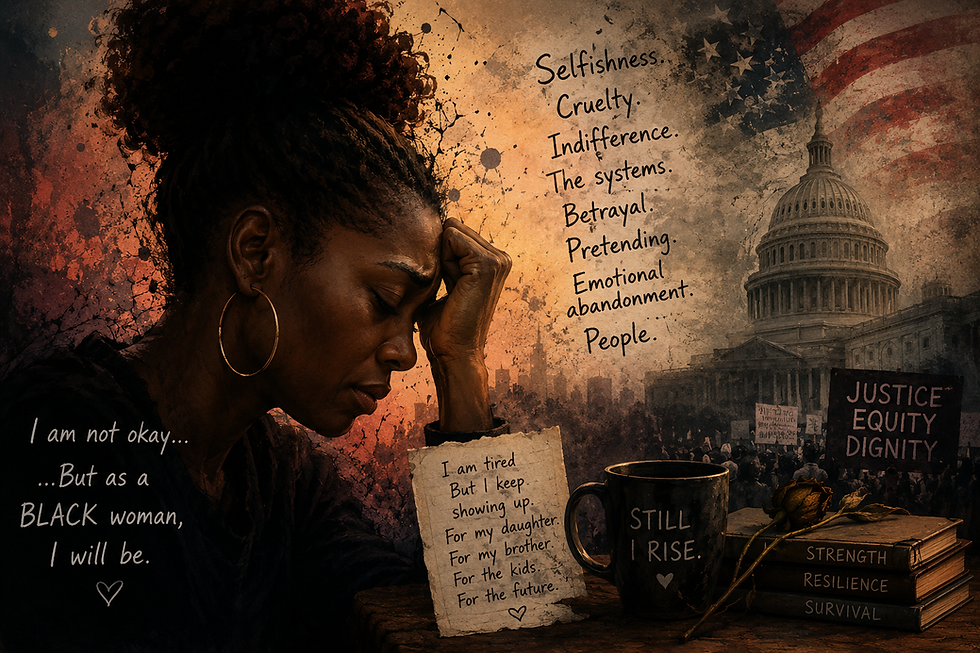
My faith made things even harder. As a Christian, I believed abortion was a sin. My biological mother offered to pay for one, but I was terrified of committing what I believed was murder. Yet having the baby meant being judged as a sinner anyway—for being unmarried, for “sleeping around.” Most people didn’t know I had been raped. They didn’t know the truth of what happened to me. To them, all they saw was another Black woman, unwed and pregnant, carrying “proof” of her so-called sin.
So no matter what I did, I was wrong. Abortion made me a murderer. Carrying made me a whore.
That’s the trap many survivors find themselves in when religion is weaponized: there is no way out. You are guilty if you abort, guilty if you carry, guilty if you keep quiet, guilty if you tell your story. And the guilt is compounded by the whispers in the church pews, the judgmental looks at fellowship dinners, the Bible verses thrown like darts instead of balm.
Some of the loudest voices around me were not offering compassion; they were offering condemnation. People quoted scripture as though it were a club. They told me that because I was not married, I was living in sin. They told me that if I chose abortion, my soul would be damned. They told me that raising a child born of rape was my punishment and that I needed to accept it with silence. There was no room in their theology for empathy, trauma, or understanding.
And when my daughter was born, the criticism didn’t stop. Instead, it shifted. Suddenly my motherhood was on trial. I was told I didn’t spank her enough, that I wasn’t “breaking her spirit” the way a “good” Christian mother should. Some even told me flat-out that if I didn’t beat her in public, I was a bad parent. To them, public displays of discipline were proof of godly parenting. But I refused to humiliate my child that way. I refused to let the church dictate that violence was the measure of love.
Still, the voices cut deep. They said my daughter was out of control, that I was too lenient, that God would withdraw His love if I didn’t parent the way they believed I should. This is what spiritual abuse looks like—when scripture is twisted into a weapon, when faith is used to control and manipulate instead of to comfort and heal.
I was already struggling under the weight of trauma, poverty, and loneliness, and now my faith community was breaking me down further. Instead of lifting me up, they pushed me lower. Instead of offering grace, they offered shame. Instead of providing support, they piled on judgment.
The contradictions were endless. On one hand, Christianity told me to value life, to cherish the soul growing inside me. On the other hand, that same community belittled me for carrying a child outside of marriage, ignoring the fact that I had been raped. On one hand, they demanded I parent with an iron fist, using fear and punishment as tools. On the other hand, they insisted that love and forgiveness were at the heart of the Gospel. Which was it? Was I supposed to nurture or destroy? Was I supposed to protect or punish?
And that’s the problem with wishy-washy religion—it traps you in impossible contradictions. It holds you hostage to standards that shift depending on who’s talking, who’s watching, who’s judging. Republicans, conservatives, even some in my own church wanted to use my life as a moral lesson: “Don’t open your legs.” “Don’t murder your baby.” “Don’t let your child misbehave.” They wanted my body, my choices, my parenting, all to serve their narrative.
But none of them wanted to sit with me in the pain. None of them wanted to help me find healing. None of them wanted to acknowledge that the reason I was in this position was because I was raped.
That is what makes spiritual abuse so dangerous—it convinces you that God Himself is disappointed in you, when in reality it is people using God’s name to mask their own cruelty. It convinces you that you are broken beyond repair, when the truth is that you are surviving the unimaginable. It convinces you that you are alone, when the truth is that countless others have been through the same contradictions, the same judgments, the same suffocating shame.
For years, I carried that shame like a stone around my neck. And in many ways, I am still unlearning it. But what I know now is this: God is not the author of confusion, or condemnation, or cruelty. People are. And the trap of religion and shame is one of the most powerful tools used to silence survivors.
When Belief Becomes Law: Real-World Consequences
It is one thing to be judged inside a church community, whispered about at fellowship meals, or criticized in the pews. That pain alone is heavy. But what happens when those same judgments step outside the church doors and become law? What happens when personal beliefs are forced onto entire populations, stripping away options for survivors like me?
This is where the trap of religion doesn’t just wound individuals—it wounds entire generations. When Roe v. Wade was overturned, it sent a clear message: that survivors of rape, children, and women in crisis were no longer trusted to make their own choices. It told us that the shame, the contradictions, the impossible double-binds I felt in church now had the weight of the government behind them.
Think about the cruelty of it: a young girl, barely a teenager, raped by a family member or stranger, is told she must carry the pregnancy. She is a child, forced to mother another child, carrying not only the weight of trauma but the weight of a system that has chosen punishment over compassion. That is not justice. That is legalized spiritual abuse.
And for women like me—Black women, poor women, women without support—this becomes a death sentence of another kind. Wealthy women, politicians, and pastors’ wives who scream “abortion is murder” often have the money to quietly fly out of state, to seek therapy, to send their kids to schools where discipline doesn’t mean humiliation. Money gives them options. Poverty leaves the rest of us with shame, trauma, and no way out.
The result is a cycle that never ends:
Mothers raising children while carrying unhealed wounds.
Children growing up with secondhand trauma, punished for their personalities instead of nurtured in their strengths.
Generations carrying the scars of violence, poverty, and spiritual abuse because the system would rather shame than support.
Republicans and conservative Christians love to wave the banner of “family values,” but what does that mean when the family itself is built on violence? What does that mean when women are condemned both for carrying and for not carrying, for parenting too strictly or for parenting too gently? What does that mean when lawmakers force birth but refuse to provide childcare, healthcare, housing, or therapy?
The real-world consequence is that survivors are silenced. Children are born into trauma with no safety net. Communities fracture. And the same people who voted for these laws wash their hands clean and call it “God’s will.”
But this isn’t God’s will. This is human cruelty dressed up in religious language. And every survivor who has ever carried a child of rape deserves to know that the shame they feel is not from God—it is from people who benefit from control.
And it isn’t only lawmakers. Churches, schools, and neighbors have choices, too. You can choose trauma-informed care instead of gossip, support instead of shame, presence instead of silence. Survivors need communities that heal, not communities that hide. And when law and shame collide with an empty wallet, the weight turns into a daily survival test.
Anger, Loneliness, and the Weight of Poverty
I was angry. Angry that my daughter didn’t listen. Angry that I couldn’t afford childcare. Angry that we lived on Section 8, and one wrong move could jeopardize everything—something as small as her inviting friends over without permission could have been the reason we lost the only roof over our heads. Angry that the man who raped me had put me in this position, and that his family pretended not to know the truth, as if denial could erase what he had done. Angry that no one in Vancouver wanted to hire me because of the color of my skin, no matter how many recommendation letters or skills I had.
That anger sat heavy inside me, and it showed up everywhere. It wasn’t just anger at my daughter—it was anger at the world. At systems that failed me. At churches that told me to pray harder instead of helping. At neighbors who looked through me like I didn’t exist. Every time I felt cornered, that anger boiled over. And when you’re a single mother, your child is the one who feels it the most.
I was also desperately alone. No support system. No Black community that embraced me. Just me and my child—and all my unresolved trauma. I came to Vancouver hoping for opportunity, thinking my skills would open doors, but instead I was met with isolation. I didn’t see faces that looked like mine, didn’t hear voices that understood my struggle, didn’t feel embraced anywhere. Poverty is not just about money; it’s about the loneliness of being invisible. It’s about carrying burdens with no one to help shoulder them.
And that loneliness feeds the anger. When you don’t have anyone to lean on, every hardship feels magnified. A sick child feels like the end of the world because there’s no one to cover your shift. A broken-down car feels catastrophic because there’s no one to loan you theirs. I remember counting quarters at the gas pump, praying the light wouldn’t come on before payday. A simple mistake feels like failure because you have no one reminding you that you’re doing your best. The absence of community makes you feel like you’re drowning alone, and every gasp for air is filled with resentment.
If I had had money back then, things could have looked so different. My daughter’s adventurous spirit—her love of taking risks, her curiosity, her boldness—wasn’t a bad thing. But when you’re poor, people don’t see adventure; they see defiance. Teachers label it as disruptive. Strangers call it disrespect. And as her mother, without resources, I had no safe ways to channel her energy. If we’d had money, I could have nurtured that spirit. I could have taken her to ride ATVs, to learn dirt bikes, to camp and hike and explore in ways that matched her personality. I could have put her in gymnastics or martial arts or let her try things that would have taught her discipline while feeding her adventurous heart. Poverty turned possibility into punishment.
And here’s where the injustice cuts even deeper: wealthy families with adventurous children get a completely different narrative. Their kids are “spirited,” “independent,” “future leaders.” They get after-school programs, music lessons, soccer leagues, debate clubs. Their curiosity is rewarded, not punished. When they talk back, people call it “critical thinking.” When they push boundaries, people call it “innovation.” But when poor kids—especially poor Black kids—show the same traits, they get labeled “problematic,” “defiant,” “out of control.” The very behaviors that signal leadership in wealthy white families are criminalized in poor Black families.
I saw it with my daughter. Her boldness, her refusal to back down, her unwillingness to conform—those were survival traits, leadership traits, but teachers and neighbors didn’t see them that way. To them, she was a problem to be managed, not a gift to be nurtured. And because I was stretched thin, with no money and no support, I sometimes fell into the same trap. I saw her adventurousness as defiance. I saw her boldness as disobedience. I saw her spirit as one more weight on my already breaking back.
That’s the cruel truth: when you have money, you have options for healing and growth. You can buy therapy, childcare, extracurricular activities, healthy food, tutors, vacations—things that seem small but shape a child’s entire development. You can give them space to test limits safely, to fail without fear of losing your stability—or your housing. When you don’t have money, you’re left trying to parent through trauma with no tools, no cushion, no backup. You’re left making impossible choices—between rent and childcare, between groceries and gas, between your own therapy and your child’s needs. And both you and your child suffer for it.
Poverty magnifies trauma. It doesn’t just add stress—it multiplies it. It turns anger into rage, loneliness into despair, and a child’s adventurousness into a constant reminder of what you can’t provide. And in the silence of all that weight, I sometimes felt like I would break.
A Turning Point
I wish I could tell you I figured it all out quickly. I didn’t. For years I struggled. I made mistakes. I hurt my child without meaning to. And yet, I also fought for her with everything I had—especially when the schools and society showed her hatred because of her skin color, her brilliance, her very existence.
What finally began to change me was God—and therapy. I begged God to change my heart toward my child. To teach me how to love her. Slowly, He did. He softened me. He showed me new ways to parent. And eventually, therapy helped me face my own trauma, too.
The love I encountered from God in that season was different from the kind of love I had been shown by people. People’s love was conditional. People’s love said: “If you behave this way, then I will accept you.” “If you carry the pregnancy, you are righteous, but if you don’t, you are condemned.” “If you discipline your child the way we approve of, then you are a good mother, but if you don’t, you are a failure.” That kind of love was rooted in shame and control, not grace.
But God’s love—the love of the Father, Son, and Holy Spirit—was something altogether different. Scripture says in Romans 8:38–39 that nothing can separate us from the love of God in Christ Jesus—not death or life, not angels or demons, not present circumstances or future fears. That verse became real to me when I felt like even my own failures as a mother had cut me off from love. God whispered: Nothing can separate you from me—not even this.
When I thought about how I loved my daughter—imperfectly, sometimes angrily, sometimes resentfully—I realized God loved me with none of those conditions. His love is patient and kind; it does not envy, it does not boast, it is not proud (1 Corinthians 13:4). People told me love meant beating my daughter into submission, but scripture said: Love always protects, always trusts, always hopes, always perseveres. Love never fails (1 Corinthians 13:7–8). That contrast was staggering.
The Father’s love reminded me that I was not alone in parenting. Psalm 68:5–6 says God is “a father to the fatherless, a defender of widows,” and that He “sets the lonely in families.” I clung to that promise. I was parenting without a partner, but I wasn’t parenting without help. God’s Spirit was with me in the quiet moments, in the tears I cried at night, in the prayers I didn’t even have words for.
Jesus’ love showed me how to forgive—not just others, but myself. When He said in John 15:12 “My command is this: Love each other as I have loved you,” I began to see that His love was sacrificial, not judgmental. He loved me enough to die for me, even knowing my sins, my mistakes, my failures. If He could love me with that kind of grace, then maybe, with His help, I could love my daughter with more grace, too.
And the Holy Spirit’s love reminded me that transformation is possible. Romans 5:5 says, “God’s love has been poured out into our hearts through the Holy Spirit, who has been given to us.” I began to feel that pouring—not all at once, but drop by drop. The Spirit softened the hardened parts of my heart, the parts that recoiled when my daughter touched me, the parts that resented her laughter when I was weighed down with sorrow.
Humans told me I wasn’t enough, that I didn’t measure up, that God’s love was dependent on my behavior. But scripture told me that God’s love is steadfast, unconditional, and unchanging. Jeremiah 31:3 says, “I have loved you with an everlasting love; I have drawn you with unfailing kindness.” That is the love that held me when I could barely hold myself together.
It was this love—Father, Son, and Spirit—that began to rewrite my story. Not instantly, not perfectly, but steadily. God showed me that His love was not like human love. Human love rejected me, but God welcomed me. Human love condemned me, but God forgave me. Human love used shame to control me, but God’s love used grace to free me.
And as His love transformed me, it also transformed how I parented. I no longer saw my daughter as a reminder of trauma but as a reminder of God’s mercy—that even in brokenness, beauty can emerge.
That was my turning point: the moment I realized that love is not something I earn, but something I already have in Christ. And from that place, I could finally begin to offer love to my daughter, not out of fear or shame, but out of grace.
Real-World Consequences of Twisting God’s Love
When God began to change me—teaching me through His Spirit that love is patient, kind, and unconditional—I also began to see more clearly the difference between His love and the so-called “love” preached by people. The contrast was staggering. God’s love lifted me, while human “love” tried to crush me with shame. God’s love told me I was forgiven and whole, while people’s version of love told me I was always guilty, no matter what I chose.
And here’s the painful truth: when human beings misunderstand or twist God’s love, it doesn’t just harm individuals—it reshapes laws, policies, and entire generations. What I lived inside the church—the constant double-bind of judgment—has now been written into law for the whole nation.
When Roe v. Wade was overturned, the message was clear: survivors of rape, young girls, women without resources—all would be forced into the same trap I lived. Abort and you’re a murderer. Carry and you’re condemned. Parent with grace and you’re weak. Discipline harshly and you’re cruel. There’s no way out because the system itself thrives on punishment, not mercy.
But the Bible says in Micah 6:8 that God requires us “to act justly and to love mercy and to walk humbly with your God.” What we see today in politics and religion is the opposite: injustice, cruelty, and arrogance. And that arrogance costs lives.
A child forced to carry a child carries trauma upon trauma. A mother raising a baby born of rape without therapy or support is carrying a weight meant for a community, not one person. A family judged and shamed instead of nurtured becomes fractured. And generation after generation inherits wounds instead of healing.
This is not the love of God. Psalm 103:8 says, “The Lord is compassionate and gracious, slow to anger, abounding in love.” Human laws that force survivors into silence and shame are not compassionate. They are not gracious. They are not patient. They are not love.
The Gospel says, “There is no fear in love. But perfect love drives out fear, because fear has to do with punishment” (1 John 4:18). Yet so much of what we see in laws and in churches is built on fear and punishment. That is not God—it is people weaponizing His name to control others.
And when Christians or lawmakers justify their choices by saying they are “pro-life,” I can’t help but remember Matthew 25:40: “Whatever you did for one of the least of these brothers and sisters of mine, you did for me.” If life truly mattered to them, they would feed hungry children, provide safe housing, pay for counseling, and walk with survivors instead of condemning them.
The real-world consequences of twisted religion are devastating. Survivors are retraumatized. Children are stigmatized. Families are left unsupported. And all the while, people claim this is “God’s will.” But scripture says the opposite: “So if the Son sets you free, you will be free indeed” (John 8:36). God’s love frees us. It does not chain us.
This is why I speak. Because until the world understands the difference between human shame and God’s true love, laws will continue to break the very people Christ came to heal.
Why I’m Writing This
I’m sharing this not because it’s easy, but because I know there are other mothers out there raising children born of rape who are drowning in silence. I know the mix of love and rage, grief and tenderness, hope and shame. I know how trauma can curl itself around your parenting until you don’t recognize yourself. And I know what it is to carry all of that while people who don’t know your story tell you how you should live it.
I want you to know:
You are not alone.
Your conflicting feelings don’t make you a monster—they make you human.
But if you don’t go to therapy, if you don’t deal with your trauma, it will find its way out through your child.
Therapy doesn’t erase what happened, but it gives your pain a place to go that isn’t your child. It gives you language for flashbacks, tools for regulation, and a way to separate your child’s personality from your trauma’s triggers. Healing isn’t quick or neat, but it is possible, and you deserve it.
I am also writing this because silence almost destroyed me. Shame almost convinced me that I didn’t deserve to be a mother, that I didn’t deserve love, that my daughter would be better off without me. For years, I lived under the weight of human judgment—of Christians who told me I was wrong no matter what I chose, of a system that saw me as disposable, of memories that told me I was unworthy.
But God’s love told me something different. Romans 5:8 says, “But God demonstrates his own love for us in this: While we were still sinners, Christ died for us.” That means His love is not conditional. It doesn’t wait for me to get it all together. It doesn’t depend on my perfection. It meets me right in the mess of my trauma and tells me: you are still mine.
That is why I am writing this—because I know there are other mothers out there raising children born of rape, carrying guilt that doesn’t belong to them, trying to love when they haven’t been loved themselves. I want them to hear me say: you are not alone.
I am writing this because I want survivors to know that the contradictions you hear from people are not the voice of God. People may say you are condemned no matter what, but scripture says, “Therefore, there is now no condemnation for those who are in Christ Jesus” (Romans 8:1). People may say your child is a mistake, but scripture says, “For you created my inmost being; you knit me together in my mother’s womb” (Psalm 139:13). People may say your pain defines you, but scripture says, “If anyone is in Christ, the new creation has come: The old has gone, the new is here!” (2 Corinthians 5:17).
And to lawmakers and religious leaders who think they can decide for us: forcing children to carry children after rape and incest is violence on top of violence. It is not compassion. It is not justice. It ignores the basic truth that trauma requires care, not coercion. If you claim to value life, then value our lives, too—fund trauma-informed counseling, protect minors from their assailants, end policies that grant rapists parental access, invest in housing, childcare, and healthcare, and stop writing shame into law. You cannot call it “pro-life” while abandoning mothers and babies the moment the birth certificate is signed.
I am writing this because the world needs to know the consequences of twisting religion into law. Jesus never called us to control one another through shame; He called us to love one another as He has loved us (John 15:12). His love was never about fear, punishment, or performance. It was about freedom, healing, and restoration.
I am writing this because my daughter’s life matters. She is not a curse, not a scarlet letter, not a mistake. She is brilliant, adventurous, and strong. And I want her to know that even though she was born from violence, she was also born into God’s purpose. The enemy meant it for evil, but God can still turn it for good (Genesis 50:20).
And finally, I am writing this because healing is possible. Not easy. Not quick. But possible. If you are a survivor, I beg you: find therapy. Find safe community. Pray if you believe. Cry if you must. Just don’t carry it alone. Isaiah 41:10 says, “So do not fear, for I am with you; do not be dismayed, for I am your God. I will strengthen you and help you; I will uphold you with my righteous right hand.” That is the God who held me when I couldn’t hold myself. That is the God who can hold you, too.
This is why I write—to tell the truth, to break the silence, to remind others of the God who heals, and to proclaim that shame has no power where love reigns.
My Hope
My daughter and I are still healing. She is still carrying her own trauma. And I still have regrets. But we are here. We are alive. We are learning, together, what it means to move forward.
I can’t rewrite the past. But I can tell the truth now. And I can say this: no survivor should ever be forced into silence, into shame, or into motherhood without support.
If you are walking this road, please, please—seek therapy. Find help. Don’t carry it alone the way I tried to. Your healing matters. Your child’s healing matters. And your story, no matter how messy, deserves to be told.
💔 This is for every mother who has ever looked at her child and seen both love and pain. You are not alone. And there is still hope.
A Prayer for Survivors, Children, and Communities
Father God,You see every hidden tear and every breaking heart. You know the stories we struggle to say out loud. We come to You as we are—wounded, weary, and wanting to heal—asking for Your presence to rest on every survivor and every child touched by violence, poverty, racism, and shame.
Lord Jesus,
You are gentle with the broken and strong for the weak. Wrap survivors in Your unfailing love where silence once suffocated them. Speak truth where lies have lingered. Where memories ache, bring relief. Where bodies hold trauma, bring release. Where relationships are strained, sow repair, patience, and new beginnings.
Holy Spirit,
Breathe peace into anxious minds and regulate hearts that race with fear. Guide each person to the practical help they need—safe counselors, supportive communities, and wise companions. Give courage to make the first call, to show up for the next appointment, to keep choosing healing when it feels hard.
For children,
Guard their hearts and futures. Let them be seen not as problems to manage but as gifts to nurture—curious, bold, and full of Your image. Surround them with teachers, mentors, and neighbors who call out their strengths and protect their dignity.
For parents,
Give stamina for each small step, tenderness that doesn’t collapse, boundaries that protect, and forgiveness—both to give and to receive. Where trauma has leaked into parenting, bring repair and redemption. Teach us to discipline without shaming and to love without withdrawing.
For churches, schools, and communities,
Trade gossip for intercession, performance for presence, judgment for justice, and shame for support. Make our spaces truly trauma-informed—places of safety, mercy, and practical care. Let our faith be known not by loud slogans but by quiet, consistent love.
For leaders and lawmakers,
Grant wisdom rooted in compassion. Move hearts to protect survivors, fund healing, and end policies that compound harm. Teach our leaders to act justly, love mercy, and walk humbly.
God of comfort and freedom,
Break every chain of spiritual abuse, hush every voice that misnames You, and lift every burden of false guilt. Where there has been darkness, ignite hope. Where there has been isolation, plant community. Where there has been fear, perfect Your love.
Make beauty rise from what was broken. Write a new chapter over every life that says: healed, held, and free.
I seal all of this in the blood of Jesus. In Jesus' name I pray. Amen.
Further Reading / Sources
The Chicago School — Trauma & Spiritual Abuse (insight/psychology): https://www.thechicagoschool.edu/insight/psychology/trauma-spiritual-abuse/
PMC / NCBI article (2023) on trauma and spiritual abuse: https://pmc.ncbi.nlm.nih.gov/articles/PMC10652570/
Centers for Disease Control and Prevention — Pregnancy Resulting From Rape: https://www.cdc.gov/sexual-violence/about/pregnancy-resulting-from-rape.html
Resources & Hotlines (for survivors, mothers, and those supporting them)
If you or someone you know is going through or has gone through sexual violence, abuse, or pregnancy from rape, here are resources that can help. These are free, confidential, and (in many cases) available 24/7:
National / U.S. Contacts
Rape, Abuse & Incest National Network (RAINN) — National Sexual Assault Hotline: 1-800-656-HOPE (4673) https://www.rainn.org
National Domestic Violence Hotline: 1-800-799-SAFE (7233) https://www.thehotline.org
Sexual Assault Kit Initiative (SAKI) — national resources for survivors and help with local referrals https://www.sakitta.org
Office on Violence Against Women (OVW) — links to local programs, legal support, and survivor resources https://www.justice.gov/ovw/resources-for-survivors
Local Washington State support line (for survivors in your region): 1-855-210-2087 (Sexual Assault Support & Information Line) https://www.wcsap.org
Other / Additional Resources
Boston Area Rape Crisis Center (for Massachusetts and surrounding area) — 24-hour Hotline: 800-841-8371 https://barcc.org
Pandora’s Project — online support, forums, and resources for survivors of sexual assault https://pandys.org
HelpGuide — articles and guides on recovering from rape & sexual trauma https://www.helpguide.org/mental-health/ptsd-trauma/recovering-from-rape-and-sexual-trauma


Comments