
When the Headlines Fade, We're Still Here: Sex, Power, and the Fight for Our Kids
- lewaubunifu
- May 20, 2025
- 12 min read

When the Headlines Fade, We're Still Here: Sex, Power, and the Fight for Our Kids
By Lewa Ubunifu
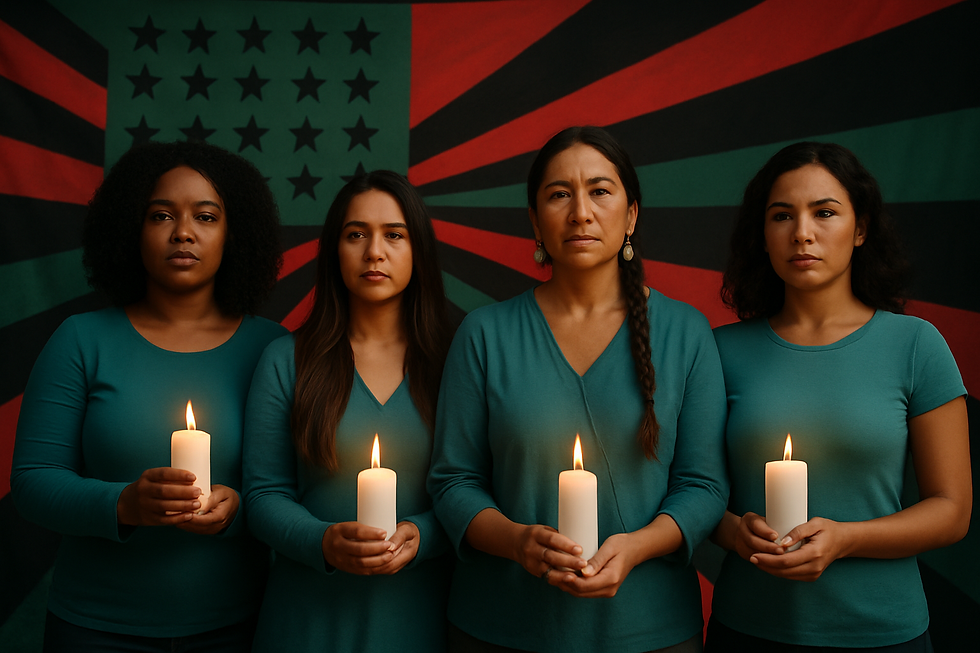
When the video of Sean "Diddy" Combs surfaced, the world gasped. But for survivors like me, it wasn't shocking—it was a confirmation of what we've known all along: this country has a deep, systemic problem with sex, power, and silence.
The case against Diddy isn’t new. Neither is R. Kelly, Jeffrey Epstein, Larry Nassar, Harvey Weinstein, or the thousands of others whose names we’ll never hear. The media treats each one like a singular event—an isolated monster—but they are symptoms of something much larger. In the United States, sexual violence, trafficking, and exploitation are not anomalies. They are embedded in the culture, the laws, and the systems meant to protect us.
What made this particular case stand out to some people wasn’t the violence—it was that it was captured. Documented. Played on loop. But for most victims, there is no video. There is no media coverage. There is no national reckoning. There is only silence, disbelief, and the heavy burden of carrying trauma that others minimize or deny.
The reactions online, the sensationalism in the headlines, the debates about whether or not we “should have known”—they all reveal how unwilling many people are to admit that this is systemic. The public can’t comprehend that this happens every day, in every community, across race, religion, class, and status. Survivors are forced to watch as their experiences are dissected by people who have never lived them, judged by strangers who have never had their boundaries shattered.
What the video confirmed for me—and for so many survivors—is that power doesn’t just corrupt; it shields. It hides the abuser behind money, fame, charisma, and lawyers. It silences the victim through shame, fear, or financial ruin. And when a system is built to protect the powerful, what happens to the powerless? We are told to “move on,” to “forgive,” to “not let it define us.” But how do you move on when the world keeps telling you that what happened to you is just the price of doing business, of trusting someone, of being born female or vulnerable?
As a survivor of sexual assault—of different kinds, across different times—I carry the weight of these stories with me every day. I carry them when I see my daughter scrolling through TikTok, when I hear music glorifying domination, when I hear of another law rolling back protections for victims. I carry them in the quiet moments when a smell, a sound, or a sudden comment brings it all back. I carry them because I never had the luxury of forgetting.
Sometimes I ask myself: If this happened to someone with money, security, fame, and visibility—and they still had to fight to be believed—what hope is there for the rest of us? And if these things keep happening—if we keep uncovering abuse but never dismantle the structures that allow it—then I have to ask a much harder question: Does my country really even care about me?
This isn’t just a personal reflection. It’s a national question.
Sex, Systems, and the State of America
Let’s be honest: the United States promotes sex everywhere—on phones, buses, in schools, in ads, in music. “Sex sells,” they say. But what’s being sold, exactly? And who pays the price?
Child marriage is still legal in many U.S. states.
Sex trafficking affects an estimated 243,000 individuals in this country at any given time.
In 2023 alone, there were 127,216 reported rape cases in the U.S.—and we know these are undercounts.
Some states allow sexual activity between 13-year-olds and older teens, under close-in-age exceptions.
We talk about protecting children, but our laws and loopholes say otherwise. We talk about justice, but only when the accused isn't rich, famous, or powerful. The rest of us—especially women, especially Black women—are left to pick up the pieces.
Meanwhile, America profits off sexualization. It’s woven into pop culture, music videos, reality TV, advertising campaigns, and social media algorithms. Children are fed these messages before they even understand what they mean. Clothing marketed to 10-year-olds mimics adult fashion trends. Beauty filters on apps erase youthfulness and push teens to present themselves in ways that invite the wrong kind of attention—and often, danger. We raise children in a society that says “don’t get raped” instead of “don’t rape.” We punish girls for how they dress in school while ignoring the adults who created the hypersexualized culture they’re mimicking.
What’s worse is that the justice system doesn’t just fail victims—it often retraumatizes them. Survivors who come forward face interrogation, victim-blaming, disbelief, and public humiliation. Their pasts are picked apart, their pain questioned. If their perpetrator holds power or fame, the survivor is painted as an opportunist, a liar, or someone “just trying to bring a good man down.” This double standard is exhausting, especially for Black women and girls, who are consistently perceived as older, more sexual, and less innocent than their white peers. It’s no accident that so many of us never report. And when we do, justice rarely follows.
The systems built to protect the vulnerable are often the same ones shielding predators. Politicians who vote against victim protections get campaign funding from corporations making money off sexualized content. Judges hand down lenient sentences to abusers because they’re athletes, or students, or “made a mistake.” Religious leaders, teachers, and mentors exploit their positions with little fear of consequence. Power continues to protect power.
And what are the rest of us told to do? Speak out. Heal. Fight back. March. Vote. But we can’t vote out trauma. We can’t protest away the shame. We can’t hashtag ourselves to safety. Until laws change, until accountability reaches the top, until survivors are believed and protected instead of picked apart, these tragedies will continue.
We say we love our children. We say we honor our women. But our laws, our media, and our justice system tell a different story—one written in the fine print of every unchecked exception, every celebrity apology tour, and every silenced victim.
The Spiritual Weight of Sexual Violence
Sexual assault is not just physical. It is spiritual. It’s like someone moves into your soul without permission and refuses to leave. There is trauma. There are lingering spirits. There’s shame that isn’t yours to carry but finds its way in anyway. The Bible talks about the sacredness of the body as a temple (1 Corinthians 6:19–20). But when that temple is violated, it takes a lifetime to rebuild.
It isn’t just about what someone does to your body—it’s about what they take from your spirit. The sense of safety, of dignity, of spiritual wholeness. Many survivors describe feeling hollow afterward, as though something sacred was stolen. That’s because it was. Something sacred was violated. The body and spirit are deeply connected. When one is broken, the other bleeds. And no matter how strong your faith is, sexual violence tests it. It shakes your trust in people, in systems, and sometimes even in God.
What makes it harder is that this type of pain is rarely visible. There are no crutches, no casts. You can smile through it. Work through it. Raise kids through it. People will call you strong without realizing that strength was forged in fire. You might look healed to others, but deep inside, you know that certain doors were closed forcefully and never fully opened again. Survivors live in that hidden space, where the soul aches even after the body stops hurting.
Spiritually, survivors often wrestle with questions that don’t have easy answers. Why did this happen to me? Where was God? Will I ever feel clean again? The church isn’t always a safe place to explore these questions. Too often, faith communities rush survivors into forgiveness, into silence, or into roles that ignore their pain. But the Bible doesn’t skip over the ugliness. It confronts it. It names it. It honors the victim and demands justice.
Take Tamar, the daughter of King David, who was raped by her half-brother Amnon. Her story ends not with healing, but with her “living in desolation” (2 Samuel 13:20). That desolation—of being unheard, unavenged, and unseen—still echoes today. Dinah, raped by Shechem in Genesis 34, was also silenced in the text. We never hear her voice. So many of us relate to that silence—not because we don’t have something to say, but because we’re tired of screaming into rooms that don’t listen.
But God listens. Even when others don’t. And He cares about justice—not just spiritual justice, but real, tangible, earthly justice. The laws of the Old Testament, especially in Deuteronomy 22, show how seriously God took the protection of women. Assault was not dismissed as “boys being boys.” It was treated as a violation so serious that it warranted the death penalty. That alone tells us how God views the sacredness of our bodies—and how far our current systems have drifted from that standard.
God doesn’t abandon the brokenhearted. He binds them. He rebuilds temples that others tried to destroy. And He gives voice to the voiceless. I believe that. Even when my voice shakes. Even when the pain still shows up in my dreams. Even when the world keeps choosing denial. God does not.
The scriptures don’t shy away from the reality of rape: Tamar, Dinah, the concubine in Judges 19—these stories are not forgotten. They remind us that this struggle is ancient and ongoing. But God’s Word also tells us not to stay silent. It tells us to fight for justice. And I will.
Our Children Deserve More
I run afterschool programs for Black and underrepresented youth. I teach them fashion, film, and journalism not just to educate—but to empower. Because I know what it feels like to be unprotected. I know what it means to grow up in a country that sees your body before it sees your humanity.
I’ve looked into the eyes of children who are already carrying more than they should. Children who have experienced bullying, racism, sexual harassment, homelessness, mental health crises, and family trauma. Children who flinch when they’re complimented because they’re so used to attention being a threat. Children who don’t feel safe at school, at home, or online. And yet, they still show up. They still create. They still try. That kind of courage moves me every day.
These kids aren’t just students—they’re the next generation of truth-tellers, artists, innovators, and leaders. But how do we expect them to thrive when the systems around them keep failing them? When courts give predators a slap on the wrist? When schools care more about dress codes than consent education? When social media feeds them content that objectifies and devalues their bodies? When churches silence their abuse to protect reputations? When parents are too overwhelmed, and therapists are too expensive or unavailable?
Some of my students have already experienced things that would break most adults. And yet, they’re told to “be strong,” “be quiet,” “move on.” But strength isn’t silence. Healing isn’t hiding. And these children deserve the kind of protection this world reserves for the powerful.
I think about the innocence of children and how quickly it’s stolen in this country. How girls are sexualized before they’re even teenagers. How boys are told that showing emotion makes them weak. How queer and trans kids are demonized, dehumanized, or erased. I think about how trauma passes from generation to generation—not just through blood, but through policy, neglect, and silence.
When we fail to protect children from sexual exploitation, we’re not just failing individuals—we’re failing society. We’re shaping a world where exploitation becomes normalized, where empathy is lost, and where cycles of abuse repeat themselves. That’s why I created safe spaces through my programs. Because I want to offer what I didn’t always have: a place to be heard, seen, affirmed, and believed.
Our kids are not safe in a world where billionaires, pastors, politicians, and entertainers can exploit them and walk away with applause. We cannot allow a culture of celebrity and silence to drown out the cries of the vulnerable. We can’t keep confusing fame with character. We can’t keep mistaking influence for innocence. We have to start listening to the children—not when it’s trending, not when it’s too late, but now.
Every child deserves more than survival. They deserve peace. They deserve joy. They deserve freedom. And they deserve a world where they don’t have to recover from their childhood just to become functional adults.
What Needs to Change
We need more than outrage—we need reform:
Enforce stronger laws to close loopholes around child marriage, trafficking, and exploitation.
Hold powerful people accountable, regardless of their status.
Fund victim support services, mental health care, and long-term trauma recovery.
Educate our kids on consent, boundaries, and spiritual wellness—not just in schools, but at home and in places of worship.
De-hypersexualize media that grooms children to normalize exploitation.
We need more than outrage—we need reform:
Outrage fades. Hashtags die out. Media attention moves on. But the trauma stays. The survivors are still here. The children are still vulnerable. And the systems that allowed their pain to happen in the first place? Still intact. If we are truly committed to creating a safer, more just society, then we must move from performative awareness to real structural change. That starts with policy, continues with accountability, and thrives through community commitment.
Enforce stronger laws to close loopholes around child marriage, trafficking, and exploitation.
The fact that in 2025, child marriage is still legal in several U.S. states is not just shameful—it’s dangerous. Predators exploit these laws to mask abuse behind a wedding license. Loopholes that allow 13- or 14-year-olds to engage in sexual activity under “close-in-age” exceptions without meaningful consent education or protections only further complicate the issue. Stronger laws must be uniform, federal, and unambiguous: no child should be legally married. No minor should be left unprotected under legal gray areas.
Hold powerful people accountable, regardless of their status.
Justice cannot depend on income, race, gender, or notoriety. Far too often, the wealthiest and most powerful walk free while victims are left with lifelong scars and no closure. Whether it’s a celebrity, a CEO, a pastor, or a politician, no one should be above the law. We must eliminate the barriers that allow the rich and connected to evade accountability—from NDAs that silence victims to legal teams that intimidate them into submission. Power should never outweigh principle.
Fund victim support services, mental health care, and long-term trauma recovery.
Healing doesn’t end when the court case closes—if it even gets that far. Survivors need accessible mental health care, legal aid, housing, and safe spaces where they can process what has happened to them without fear or shame. These services are often underfunded, overburdened, or inaccessible—especially for low-income and BIPOC communities. It’s not enough to say “we believe you” without offering the tangible resources that make belief meaningful.
Educate our kids on consent, boundaries, and spiritual wellness—not just in schools, but at home and in places of worship.
Too many children grow up not understanding what consent looks like, what their rights are, or how to speak up when something feels wrong. Comprehensive, age-appropriate education about bodily autonomy, healthy relationships, and red flag behaviors can’t just be optional—it must be a societal priority. And it can’t fall solely on schools. Parents, guardians, churches, mosques, and community organizations must all be equipped to have these conversations early and often.
De-hypersexualize media that grooms children to normalize exploitation.
The media is raising our kids as much as we are—often more. Platforms that profit off clicks and views don’t care about the mental, spiritual, or emotional impact of what they push. When children are constantly shown that their worth is tied to their appearance, their body, or their desirability, we are grooming them into silence, shame, and vulnerability. Regulation is needed. So is a cultural reckoning with what we consume, what we promote, and what we excuse.
Real change means reimagining everything—how we define protection, how we build community, how we honor the sacredness of every person, especially our most vulnerable.
Final Word: We Are the Voices
To survivors: I see you. You are not alone. Healing is not linear. Some days you’ll be strong. Some days you’ll fall apart. Both are valid. Both are sacred. You don’t have to prove your pain. You don’t have to relive it for others to believe you. You don’t have to carry it in silence, and you don’t owe anyone your survival story. Whether you whisper it, write it, shout it, or choose never to speak it at all—your voice, your experience, and your life matter.
To the rest of the world: Don’t wait for the next scandal. Don’t wait for a video. Don’t wait until the abuser is someone you don’t admire or someone you don’t know personally. Don’t let the headlines dictate your compassion or your urgency. The time to care is not when it becomes convenient or undeniable. The time to act is now—because by the time it hits the news, someone has already suffered in silence.
Sexual assault is not a trending topic. It’s not a headline. It’s not a documentary to binge or a scandal to gossip about. It is a generational wound—passed down through silence, denial, fear, and normalized violence. It affects how people parent, how they love, how they trust, how they exist in the world. It lives in their bodies and bones. It shows up in their anxiety, their depression, their addictions, their rage. This pain echoes—and it ripples into communities, generations, and futures.
But if we tell the truth—loudly, unapologetically—we can change the narrative. Not just for ourselves. For our children. For their future. Every time we break the silence, we weaken the shame. Every time we confront a system, we push it to evolve. Every time we believe a survivor, we make it harder for predators to hide behind power and privilege. It starts with us. With choosing discomfort over denial. With choosing action over avoidance. With choosing humanity over reputation.
We are the voices of those who were silenced. Of those who were not believed. Of those who didn’t make it. We speak because some never had the chance. And we will not let the next generation grow up thinking their pain is invisible or that justice is a luxury reserved for the rich. We will not let them believe that their bodies are commodities or that their boundaries are negotiable. We will not let them inherit a world that treats their suffering as acceptable collateral.
Because they deserve a country that doesn’t just protect power—but protects the powerless. They deserve communities that prioritize safety over secrecy. They deserve schools, churches, courts, and homes that believe them, fight for them, and center them. They deserve healing, not just survival.
And we? We are the ones who will make sure of it.
Not just with our pain—but with our power.
Not just with our wounds—but with our voices.
Not just with our stories—but with our actions.
We are the voices. And we are just getting started.



Comments