
When Racism Becomes Entertainment, Our Children Pay the Price

When Racism Becomes Entertainment, Our Children Pay the Price
By Lẹwa Ubunifu

I am tired of people dismissing racism as “just a joke.”
Over the past several days, my social media feeds have been flooded with clips from the roast involving Kevin Hart. Everywhere I looked, people were reposting clips, laughing, debating, and defending what was said. But the more I watched, the more disturbed I became.

Not because I “can’t take a joke.”Not because I am “too sensitive.”And not because I expect comedy to be clean, soft, or politically correct. I was disturbed because many of the jokes were rooted in racism, humiliation, trauma, and pain that Black communities are still living through right now. There were jokes referencing George Floyd, a Black man whose death exposed the brutality of policing and racial injustice in America to the entire world. There were jokes involving personal tragedy and suicide. There were moments that did not feel clever or insightful. They felt cruel. They felt dehumanizing. They felt like racism and pain had simply been repackaged as entertainment for mass consumption.
And then came the predictable responses:
“Relax.”
“It’s comedy.”
“Everybody gets roasted.”
“Stop being so offended.”
"Freedom of Speech."
"1st Amendment."
But here is the problem: Not all jokes land in the same social context. Jokes about systemic racism, police brutality, slavery stereotypes, racial violence, or murdered Black people do not exist in a vacuum. They are connected to real trauma, real discrimination, and real experiences that many African American families are still dealing with every single day.
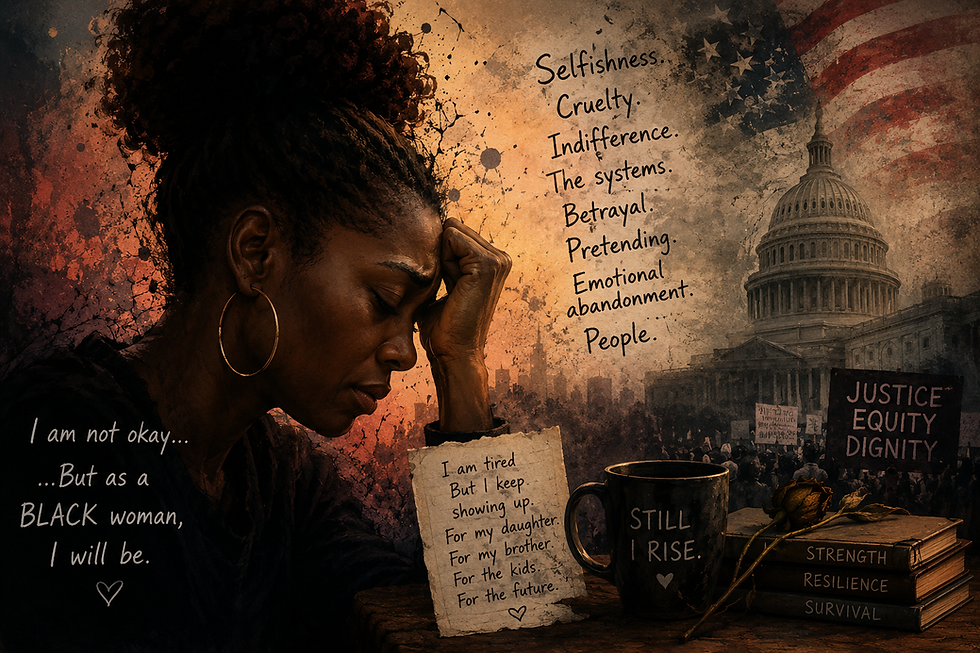
As a mother, youth advocate, educator, and African American woman, I cannot separate those jokes from the reality our children walk into every morning when they enter schools across America.
I see the bias.
I see the stereotyping.
I see the racial disparities in discipline.
I see Black students treated differently for the same behavior.
I see children mocked for their hair, speech, culture, skin tone, or identity.
I see the emotional damage caused when young people are constantly forced to defend their humanity in spaces that should already respect it.
So when celebrities stand on massive platforms and make racially charged jokes for millions of viewers, people act as though the damage stops at the stage.
IT DOES NOT!
Those jokes travel. They travel through Netflix. They travel through TikTok clips. They travel through Instagram reels. They travel through school hallways. They travel through classrooms. They travel through group chats. And eventually, they land in the mouths of children who repeat what society rewards with laughter. Kids repeat what they hear adults celebrate.
That is why this matters.
A celebrity may perform a joke for shock value and walk away rich, applauded, untouched, and trending online. But the attitudes behind those jokes absolutely trickle down into schools, workplaces, online bullying, and everyday interactions.
When society constantly frames racism as humor, people slowly become more comfortable with cruelty. And honestly, that is what scares me the most. What also frustrates me is the selective amnesia people suddenly develop when race enters comedy. America has a very long history of turning Black pain into entertainment while simultaneously denying Black people basic humanity, equality, and protection.
For generations, Black people were mocked in minstrel shows.
Mocked through stereotypes.
Mocked while being segregated.
Mocked while being lynched.Mocked while being denied opportunities.
Mocked while being criminalized.
Mocked while fighting simply to survive in systems that were never built equally for us.
So no, many Black Americans are not going to sit comfortably and laugh while racial trauma becomes content for streaming platforms and viral clips.
History matters.
Power matters.
Context matters.
And for some of us, it is exhausting watching racism disguised as “edgy humor” continue to be normalized in mainstream entertainment. People keep saying: “Well, freedom of speech.” Freedom of speech does not erase responsibility. Just because something can be said does not automatically make it intelligent, ethical, compassionate, or harmless. There is a difference between comedy that challenges power and comedy that reopens wounds tied to real suffering.
And honestly, if these jokes were simply private conversations among celebrities, that would be one thing. But once something is packaged, monetized, streamed globally through platforms like Netflix, clipped for social media, and consumed by millions of people, it stops being “just a joke.” It becomes part of public culture. And public culture shapes behavior.
That behavior eventually affects real people. Real children. Real classrooms. Real communities.
As someone who works with youth, I am deeply concerned about the desensitization happening in our society. We are raising children in a culture where humiliation is entertainment, cruelty is called honesty, racism is defended as comedy, and empathy is mocked as weakness. Then people wonder why students bully each other.
Why bias continues.
Why some children grow up lacking compassion.
Why Black students continue to feel unsafe, stereotyped, or emotionally exhausted in educational spaces.
Because children absorb what society normalizes.
And I will say this clearly:
I am not going to laugh at racial jokes rooted in the suffering of my community while Black children are still experiencing racism in real life.
I am not going to laugh at jokes tied to police brutality while mothers fear for their sons.
I am not going to laugh at murdered Black people becoming punchlines.
And I am not going to pretend this only affects celebrities when these attitudes eventually spill into everyday life for ordinary people trying to survive systems that are already unequal.
Comedy should make people think.
Comedy should make people connect.
Comedy should challenge power without stripping away humanity.
But when humor depends on racism, humiliation, trauma, or the suffering of marginalized people, society has to ask itself a serious question:
Are we truly laughing together?
Or are we simply becoming more comfortable with cruelty?


Comments