
When Black Women Speak Up, We’re Told to Be Quiet

When Black Women Speak Up, We’re Told to Be Quiet
A Black mother’s reflection on accountability, bias, and why community matters

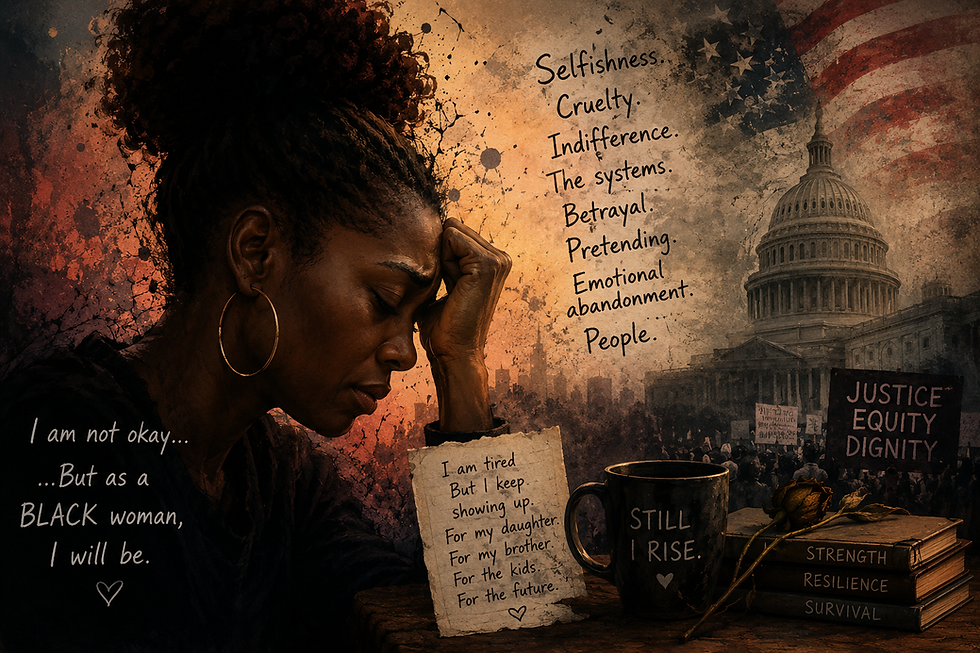
There is a particular exhaustion that comes with being a Black woman in predominantly white spaces—especially when you are advocating for your child.
It is the exhaustion of constantly being undermined, minimized, and dismissed, while being expected to remain calm, polite, and grateful for whatever scraps of attention or care are offered.
I know this exhaustion intimately.
As a Black mother, I have spent years walking into meetings prepared—documents in hand, concerns clearly articulated, solutions proposed—only to be brushed off, delayed, or treated as if I am overreacting. When I raise my voice even slightly, when my frustration shows, the focus shifts away from the issue and onto me.
Suddenly, the problem isn’t bullying.
It isn’t academic failure.
It isn’t sexual harassment.
The problem becomes my tone.
The Unequal Standard of Accountability
White people in positions of authority are often allowed to say whatever they want—dismissive comments, minimizing language, subtle digs rooted in bias—without consequence. Their words are framed as misunderstandings, stress, or simply “how things are.”
Black women do not get that grace.
Our words are scrutinized.
Our emotions are pathologized.
Our advocacy is labeled as aggression.
Research backs this up. Studies show that Black women are consistently perceived as more aggressive, less cooperative, and more threatening than their white counterparts—even when exhibiting the same behaviors. A 2018 study published in Psychological Science found that Black women are more likely to be punished for assertiveness in professional and institutional settings, while white women are often rewarded for it.
This isn’t about personality.
It’s about bias.
When Advocacy Is Treated as a Threat
I have been told—implicitly and explicitly—to be patient.
To let things play out.
To stop pushing.
To trust systems that have already failed my child.
But patience becomes complicity when a child is suffering.
When a Black mother speaks up about bullying, isolation, or academic neglect, we are often treated as inconveniences rather than partners. When we insist on accountability, we are framed as hostile. When we refuse to be quiet, we are seen as the problem.
Yet research shows that Black students—especially Black girls—are disproportionately impacted by bullying, exclusion, and disciplinary neglect. According to the National Women’s Law Center, Black girls experience higher rates of school-based harassment while receiving less protection and fewer interventions than their peers. Chronic bullying and isolation are directly linked to increased rates of depression, anxiety, academic disengagement, and dropout.
So when Black women raise the alarm, we are not being dramatic.
We are responding to documented harm.
Anger Is Not the Issue — Injustice Is
There is a long, violent history in this country of punishing Black women for expressing anger—while excusing the systems and behaviors that cause it.
But anger is not the threat.
Silence is.
Anger is often the only language left when reason has been ignored, emails unanswered, and meetings reduced to performative listening. Black women are expected to endure mistreatment quietly, and when we don’t, our humanity is questioned.
Yet sociological research consistently shows that suppressed anger—especially in marginalized groups—leads to long-term psychological harm. Being forced to remain silent in the face of injustice is not resilience; it is erosion.
Why Black Community Is Not Optional
This is why a close-knit Black community is essential—not just culturally, but for survival.
In Black spaces, I don’t have to explain why something hurts.
I don’t have to justify why I’m upset.
I don’t have to soften my words to protect someone else’s comfort.
Black community is where:
Our experiences are believed the first time
Our children are protected, not questioned
Our anger is understood as care
Our boundaries are respected
Historically, Black communities have had to rely on each other because institutions were never designed to protect us. Mutual aid, advocacy, and collective care have always been our lifelines.
The Cost of Being Told to “Let It Go”
Every time a Black woman is told to calm down, to be patient, or to stop making waves, the message is the same:
Your dignity is negotiable.
But silence costs us everything.
It costs our mental health.
It costs our children their safety.
It costs our communities their stability.
Research from the CDC and APA shows that chronic exposure to discrimination and institutional neglect significantly increases stress-related health conditions in Black women, including anxiety, depression, and hypertension. The expectation that we absorb harm quietly is not neutral—it is dangerous.
Accountability Is Not Hatred
Calling out bias is not anti-white.
Demanding accountability is not divisive.
Protecting our children is not hostility.
Accountability is how systems improve.
Responsibility is how trust is built.
Respect is how equity begins.
If the truth makes someone uncomfortable, the discomfort is not the problem—the behavior is.
We Are Allowed to Be Human
Black women are allowed to be:
Angry
Protective
Emotional
Firm
Unapologetic when it comes to our children
We are not required to endure disrespect gracefully.
We are not required to justify our humanity.
We are not required to accept systems that harm us.
And we are not wrong for choosing truth, community, and protection over silence.


Comments