
Caucasophobia

Updated: Dec 2, 2025
Caucasophobia: Understanding the Complexities of Fear and Hatred
Fear or hatred of whites; fear or hatred of people of European descent. Often associated with racism against whites. This hatred is sometimes framed as justifiable and often is not viewed as racism.

The Weight of Cleaning
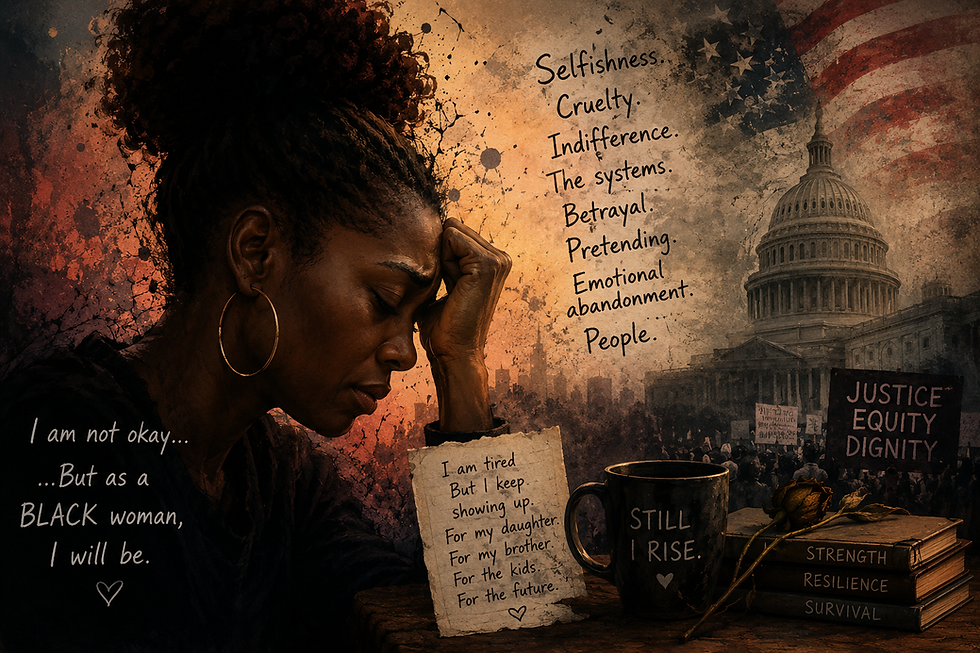
Lena Rivers cleaned the bathroom first. Not because it was the dirtiest room, but because it was the room she needed to feel human inside of. She tied her hair up, pulled on gloves, cracked the window, and pressed play on her cleaning playlist—Mahalia Jackson, CeCe Winans, Tasha Cobbs, Tamela Mann. Not loud. Never loud. Just enough to steady her breathing while she scrubbed. When the world threatened to overwhelm her, Lena cleaned.
Virgos don’t fall apart. They reorganize.
“Precious Lord, take my hand…”
Right on cue, the screen door across the yard creaked open. Mr. Thornton stepped onto his porch on the left side of Lena’s house. He always did this when her music came on—even when it was soft, even during the day, even though it was her house, her peace. Sometimes he said nothing. Those were the worst days because silence has a way of listening. Other days, he spoke.
“Some of us try to keep quiet neighborhoods,” he’d called once when her windows were open and her volume barely a whisper.
She nodded and turned it down a notch—not for him, but for herself. Because anger rattled inside her ribs like something with teeth, and she could not afford to let it out.
The Neighborhood Watch
Across the fence on the right side lived Mara. Friendly. Too friendly. She had arrived the first day with a basket of muffins wrapped in red gingham. “Welcome! If you ever need anything, I’m right next door. I hear everything through these walls.”
Everything.
Lena smiled, accepted the basket politely—because Black women know how to protect ourselves without showing our guard—and set it on the counter. Lena’s thoughts began to ramble.
We don’t eat at everybody’s house. We don’t know how you cleaned your kitchen. We don’t know how you cook. We don’t trust kitchens we haven’t seen.
After Mara left, Lena wiped the counter twice. Once to clean. Once to confirm. Mr. Thornton logged her existence as a problem—her music, her car, her hours. Soon a police cruiser began rolling past some evenings. Not stopping. Not speaking. Just looking. That was how white neighborhoods reminded you they were watching.
The Fear of Permission
Lena didn’t fear white people in the abstract. She feared what they were allowed to do. She had watched a Black man die in a trauma bay because a white attending ignored his diagnosis. She had watched a white woman die because the woman refused treatment from Lena and demanded a different doctor who didn’t know what to do. Her father had been killed by police when she was nine. Her brother was in prison for a crime DNA proved he didn’t commit.
She didn’t fear white people. She feared permission.
When the hospital transferred her from D.C. to Woodland, Washington, they called it an opportunity.
“Rural communities need strong providers.”
“Leadership potential.”
“Career growth.”
“Three weeks to relocate.”
Woodland was small. Quiet. Too quiet. The house they placed her in leaned against a thick wall of pines—tall windows that turned into mirrors at night, silence that felt like being watched. Mara on the right. Mr. Thornton on the left. Lena in the middle of their watching.
Confrontations and Exhaustion
The first confrontation with Thornton was about trash bins. “Pick-up’s Thursday. We don’t leave bins where the street can see. That’s how neighborhoods look… unkept.” No HOA. She moved them anyway—not out of fear, out of exhaustion.
The second time, she opened her garage at 11 p.m. after a long shift. “Some of us go to bed early. Be respectful.” She apologized with her face, not her voice.
The third time, he took a package off her porch and knocked. “Looked suspicious. I was about to call the police.” “My name is on the label,” she said. He held the box one beat too long before letting go. That night, police circled the block twice.
Within a week, Mara somehow knew Lena’s schedule: when she came home, when she woke up, when she paced at night. She offered help Lena never asked for, information she didn’t need. Affection isn’t always kindness. Sometimes it’s invasion wearing perfume.
Seeking Connection
This was when Lena downloaded a dating app. Not for love. For breathing room. For someone who wouldn’t look at her like she was trespassing in her own life.
She filtered for Black matches only. But filters leak. That’s how she found him: E. No picture. Just words—steady, careful words from someone who sounded like grief had sanded his edges smooth. They messaged at night about hospitals, about loneliness, about how your bones ache after holding yourself together too long. He didn’t try to fix her. He sat with her pain in silence that felt like company.
When she asked for a photo, he replied: “I don’t take pictures. Trauma. But you can Google me.” She did. His name existed. His degrees, conference panels, quotes in journal articles. But no photos. None. People don’t vanish from pictures unless they want to.
“Are you Black?” she typed. “I’m a half-breed,” he wrote. “It’s complicated.” Her body went very still. No one she knew who was mixed called themselves that. The word carried chains. She didn’t block him. Woodland was so quiet, and his voice didn’t feel like surveillance.
The Night of the Knocks
One evening, while she wiped the bathroom mirror, a cruiser rolled up. “Noise complaint,” the officer said, polite on the surface. Her music wasn’t on. Thornton stood on his porch, arms crossed. The officer left after two minutes. Thornton stayed for thirty.
She didn’t sleep that night.
E: Rough day?
She hadn’t told him.
Lena: I feel watched here.
E (voice): You are. But you’re not alone. I’m with you.
His voice slid into her like warmth. Or danger disguised as comfort.
Two days later, a plain, unmarked package appeared on her porch. Inside: Surviving White People—her favorite book. She had only mentioned it once, to her neighbor, Mara.
A note inside: For when remembering helps you survive.
—E.
Her hands shook. Someone knew her too well. Someone was learning her too fast.
That night, at 3:07 a.m., there were three slow knocks on her bedroom window. Not the door. The window.
Her phone vibrated.
E: I can feel you awake.
She froze. Turned her head.
She could see Mara’s porch light on through her window. Mara stepped outside. Barefoot. And stared at Lena’s window. Not waving. Not calling out. Just watching. Like she had always been watching. Like she was waiting for the moment Lena understood: she was never alone.
The Morning After
The next morning, Lena cleaned for two hours before her shift. No music. Just breathing. Bathroom first, then kitchen. Not because they were dirty—everything was spotless. Because control kept the walls still.
E: You made it through the night.
She hadn’t told him about the knocks. Or the porch light. Or Mara.
Lena: I didn’t sleep.
E: You don’t have to go through this alone. Let me see you.
Lena: Where?
E: Café by the lake after work. Quiet. Peaceful.
She should have said no. However, silence was beginning to feel like drowning.
Lena: Okay.
That night, the bell chimed when she walked in. Heads turned, then pretended not to. Lena sat near the window, back to the wall, eyes on the exit.
E arrived smiling—white, not “half.” He slid into the chair opposite like this was natural. The waitress looked only at him. Lena ordered tea. E ordered coffee. The waitress brought E’s coffee and walked away.
E stood and slipped into the seat beside her. Too close. His fingers brushed a curl. “Don’t,” Lena said—soft, firm.
He laughed. “I was just being friendly. Why do y’all always get so sensitive?” She turned her head slowly. “Y’all who?” The waitress returned to ask E if he wanted food. “I still haven’t received my tea,” Lena said.
A tightened mouth. “I’ll get it.”
“I’m going to the restroom,” Lena told him, rising evenly. Lena carefully walked toward the bathroom, not prey-like—controlled.
She passed the restroom, took the staff corridor, and slipped through the unsigned back exit into a narrow alley. She did not run. She left.
Her phone buzzed as she unlocked her car.
E: Don’t be afraid.
The café’s bell chimed again. Mara stepped outside from the café front door, and her eyes found Lena’s car instantly, and she smiled—not polite, not apologetic. Possessive.
Dusk turned the pines into black pillars by the time Lena pulled into her driveway. Two patrol cars idled with lights off. Mr. Thornton stood on his porch near the fence line.
“Routine check,” an officer said. “Your neighbor reported shouting.”
“From my house?” A shrug. “He heard a man’s voice.” Lena could’ve sworn she saw Mara’s curtains twitch. A silhouette lingered. Watching.
Inside, Lena locked the door and turned off every light. The forest—usually whispering—was perfectly still.
E: We need to talk.
No reply.
E: I’m outside.
Headlights dragged over her wall.
A knock at the door. “Lena? It’s me,” he said softly. “Please. Let me explain.” She stepped back. The knob twitched, shook, and then turned—she’d forgotten the deadbolt. She had locked the bottom lock but not the top one. E slipped inside, water and something metallic on his clothes. “You’re not safe here,” he whispered. “Let me help you.”
“You broke into my house.”
“I’m not like them. I get you. I understand you.” His fingers reached for her hair again. “Don’t touch me.” She shouted and punched air at the same time.
He flinched. “You always think the worst of me.”
The Escape
She snatched a vase. He grabbed her wrist. The vase fell—shattered. A bright smear of red at his temple from a piece of the shattered glass. “You’re scared of me because I’m white,” he said. “I’m scared because you won’t stop,” Lena shouted back.
She kicked his shin, tore free, sprinted through the kitchen, and out the back door into the trees. He followed.
Branches clawed. Roots rose like traps. “Lena!” he called. “You’re overreacting!” She stumbled; a hand clamped her ankle. “Got you.” She kicked—heel to jaw. He fell. Her hand closed around a broken branch, heavy and jagged. When he lunged again, she swung. He crumpled.
She ran until the porch light shimmered through the mist. E’s car sat crooked in her drive. Behind it, two patrol cars flashed red-blue. Thornton leaned on the side of the porch railing, pleased. Mara stood on her porch, robe cinched.
“Ma’am, hands where we can see them!”
“I live here! He broke in—he’s in the woods!”
Inside, flashlights swept. “Dispatch, possible assault—blood on the floor.” A shard of the vase glittered in an evidence bag. “It’s his blood!” Lena cried. “He grabbed me!”
“Where’s the weapon?” an officer asked.
Her hands were streaked red. “Turn around, ma’am.”
The cuffs were cold. Thornton crossed his arms. “Knew she’d cause trouble.” Mara’s voice floated, soft as gauze: “She’s a good person. Maybe just… overwhelmed.”
Fluorescents hummed in holding. Time thinned. Finally, the door clanged open. “Dr. Rivers,” the guard said. “You’re free to go. Someone posted bail.”
Morning smelled like wet asphalt outside. A beige sedan idled at the curb. Mara stood by the passenger door, with a smile small and deliberate. “Get in,” she said gently. “You’ve had enough humiliation for one night.”
“Why would you bail me out?”
“Because I watched them cuff you for surviving,” Mara said. “Someone had to do the right thing. You don’t have anyone here, Lena. And you’re making enemies fast.”
They drove in silence. When they reached Lena’s house, Mara eased past the driveway. “Let’s not go in there,” she murmured. “Your door’s broken. That place feels… heavy. Rest at mine. Just for the morning.”
Exhaustion weighed more than suspicion. “Just a little while.”
Mara’s house was immaculate: symmetrical, airless, no photos. “Sit,” she said. “I’ll make tea.” Chamomile—and something Lena couldn’t place. “You need to calm your nerves,” Mara said. “You’ve been through hell.”
Lena sipped. Warmth spread too fast.
“Mara… what’s in this?”
“Just a little something to help you rest.”
The room tilted. A second figure stepped from the hallway... E.
Darkness.
The Truth Revealed
Concrete, damp, a single bulb. A metal cage welded into the corner. Lena woke on a cot, hands cuffed in front, body heavy.
Footsteps. The door creaked. Mara descended. E followed, a bandage across his temple. “You should’ve stayed quiet,” Mara said, voice smooth as glass. “You had people worried.”
“You drugged me,” Lena rasped.
“I saved you,” Mara said. “This town would have eaten you alive.”
“You’re both insane.” Mara smiled. “You call it insanity. We call it protection.”
“Protection from what?”
“From yourself,” E said softly. “You see monsters everywhere. So we brought you where you can’t be hurt.”
“How do you two even know each other?” Lena asked.
Mara’s smile thinned. “You really didn’t notice his last name?”
“You never told me.”
“Thornton,” Mara said quietly. “Same father. Different mothers.”
“You’re siblings,” Lena whispered.
“Half,” E said. “Blood is blood.”
“What do you want from me?” Lena asked.
“I just want what everybody wants…,” he stated, “…to be loved.”
Lena replied, “And you—” to Mara—“helping him get what he wants.” Mara didn’t deny it. “He deserves someone who sees him. Someone strong enough to love past fear.”
“I hit him because he chased me through the woods.”
“You panicked,” E said gently. “Like you always do. You’re going to stay down here until you learn to listen.”
The next day came quickly. Lena barely slept through the night.
The Aftermath
The night before, Thornton had heard the banging and shouting. He’d called it in. Dispatch told him it could wait till morning. So he waited—on his porch before sunrise, cigarette low.
By morning, two cruisers rolled up. The officers moved without hurry. “Again, Mr. Thornton?” He jerked his chin toward Mara’s house. “Lights on till three. Now dead silent. And you didn’t find that doctor, did you?”
Silence. Thornton smirked. “Maybe she’s finally dead. Might bring some peace and quiet.”
At the station, phones were ringing—the Woodland hospital and D.C. Both wanted a welfare check. Dr. Rivers never misses shifts, they said. Ever. That made it official.
Lena’s door was still wide open when they arrived, so the cops decided to take Mr. Thornton up on his inquiry and question Mara.
The officers knocked hard. Mara opened in a tidy sweater. “Noise? We were watching a movie.”
“Ma’am, come with us,” the lead said. “And you too, sir.” E appeared at the stairs. “You can’t just—”
“We can. Easy way or hard way.” Cuffs. Rights read. Thornton pleased. Doors thudded. Engines idled. The house exhaled.
Lena didn’t move until the last bootstep left and cruiser doors shut. Only then did she pull a long bobby pin from her hair—small, familiar, enough. No clever telling of technique—just breath and patience and the feel of metal giving way. Click. One cuff. Click. The second. The cage lock, stubborn, then surrendering.
She climbed a stool to the grimy window, shouldered the frame until the old wood groaned and the glass gave with a muffled crack. Shards stung her palms. She kept going.
Outside: morning’s indifferent light. Up the street: cruisers rolling off with Mara and E inside.
On his porch: Thornton, satisfied, not even looking her way.
Lena dropped into wet grass, kept low along the garage, crossed to the hedgerow where her car crouched. She remembered her keys were back in the house. She stealthily tiptoed back up and into her house, making sure as to not draw attention to herself, grabbed her keys, and headed back toward her car. She was sure Mr. Thornton would see her, but he just sat on his porch smoking a cigarette. It almost looked like he was asleep. She jumped into the car and tried to start the engine. The engine turned on the first try, loyal as an old friend.
She pulled away as the house shrank to a rumor in the mirror.
The radio spat a bulletin: “Two Woodland residents detained for questioning in the disappearance of Dr. Helena Rivers. Evidence recovered. No further details.” Lena turned the volume down. The forest unstitched behind her. The highway cut east like an answer.
“I’m not afraid of white people,” she whispered. “I’m afraid of what they’re allowed to do.”
The road kept going. So did she.
Weeks later in D.C., office lights and coffee steam felt almost ordinary. She told her supervisor everything—the knocks, the lake café, the home invasion, the basement cage, the police, the escape. Woodland Medical had called the police too; that, plus her D.C. boss’s relentless phone records, was the only reason anyone took it seriously.
She went home to an apartment with two deadbolts, security cameras, hidden cameras, and a chair under the handle. At night, she kept a single bobby pin on the nightstand. Not as a tool. As a reminder: she opens what tries to hold her.
Some nights, sleep came. Others: not yet.
One afternoon, a padded envelope arrived—no return address. Inside: a worn paperback of Beloved. A note in careful block letters:
Still here. I am not going anywhere. I will always love you. I will always find you. You don’t have to run. You don’t have to be afraid. I am not your enemy.
She closed the door. Checked the locks. Listened to the silence until it told her nothing—and then listened longer, until she could hear her own breath steadying in it.


Comments